Reinforcements for the Crimea; troops being ferried out to their transports prior to sailing
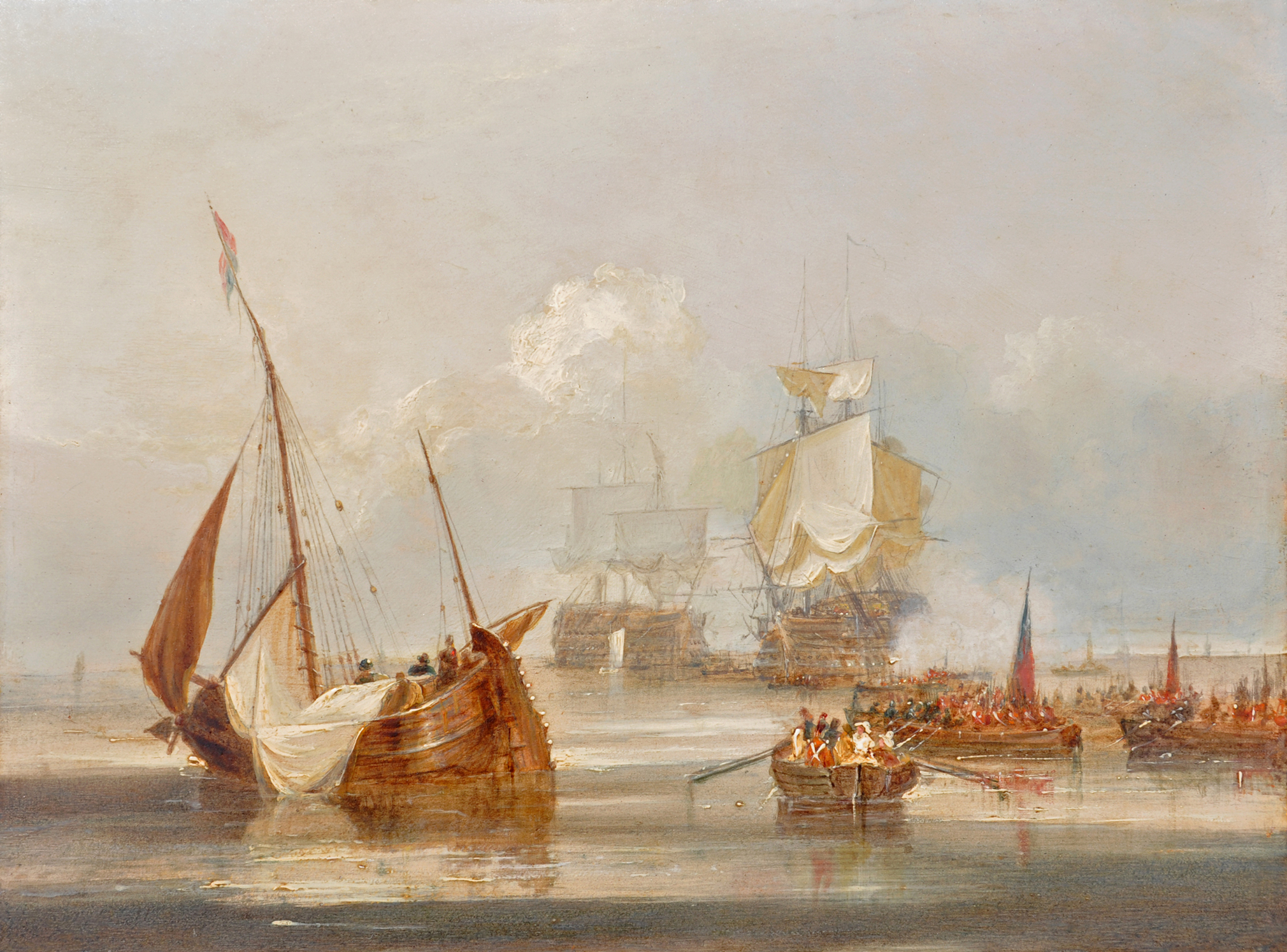
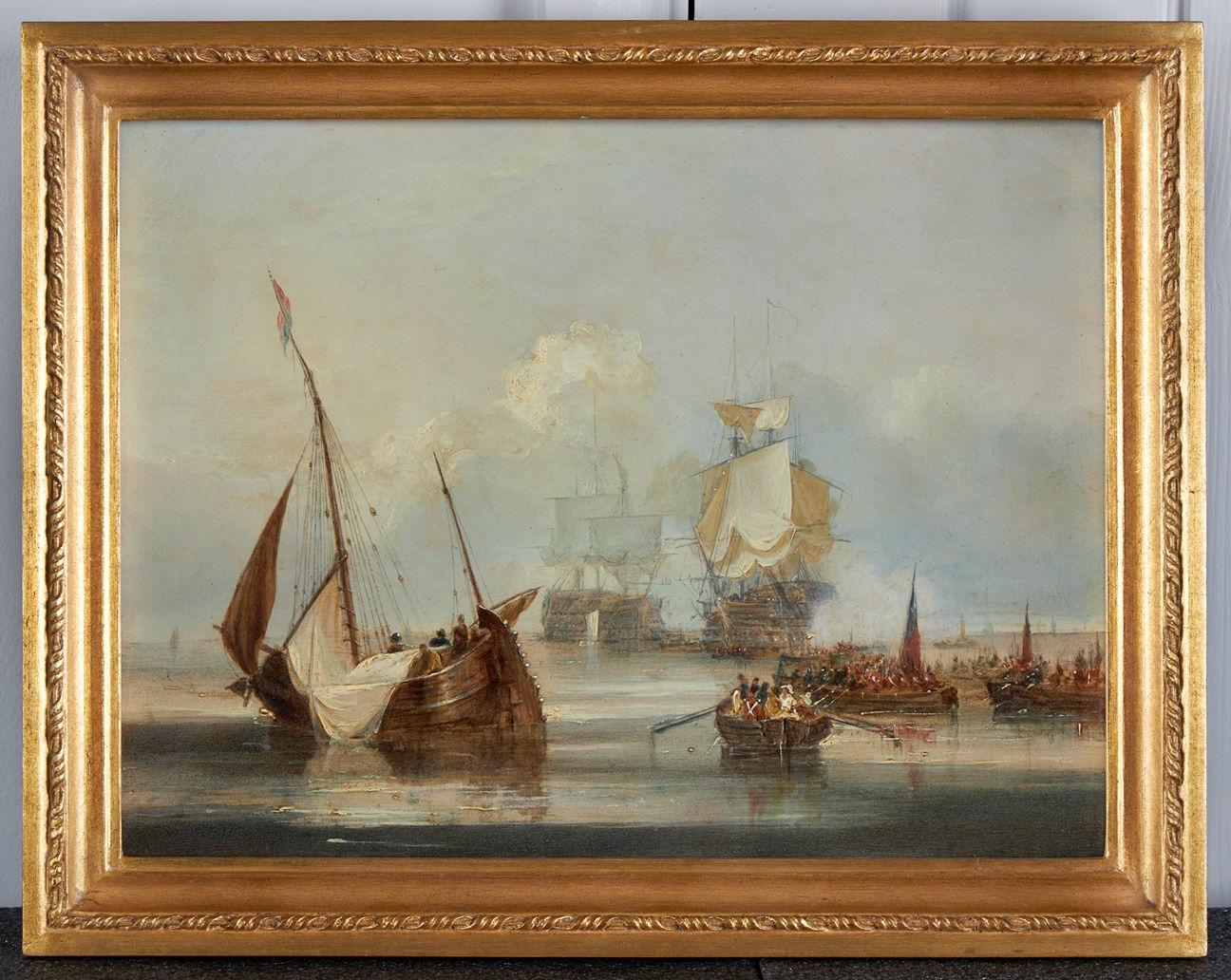
Reinforcements for the Crimea; troops being ferried out to their transports prior to sailing
JOHN WILSON CARMICHAEL
English School
1800-1868
Reinforcements for the Crimea; troops being ferried out to their transports prior to sailing
Oil on board
26 x 35 cms
10¼ x 133/4 inches
Overall framed size 32.3 x 40.8 cms
123/4 x 161/8 ins
John (also known erroneously as James) Wilson Carmichael was a highly regarded 19th century marine and landscape artist who spent the first forty-five years of his life in Newcastle.
He was born on 9th January in the Ouseburn area of Newcastle upon Tyne and was the eldest of three children. His father William was a ship’s carpenter and his mother Mary was the daughter of a seaman. In his teens, John went to sea for three years, working on a ship which plied its trade between ports in Portugal and Spain. On his return to the North-East, he followed in his father’s footsteps and started an apprenticeship as a shipwright at the ship building firm Richard Farrington and Brothers. The Farringtons however were not involved solely in the construction ships as they also were also engaged in wood carving and gilding, cabinet making and upholsterering which brought them into contact with the cultural life of Newcastle. Joseph Farrington, in particular, recognised a talent in the young Carmichael and bought him a box of watercolours.
The Carmichael family lived near the Quayside so there was constant activity to be observed with ships coming and going. John devoted his spare time to studying the subject matter that interested him and drawing it. He met and befriended Thomas Miles Richardson Snr. (1784-1848), at that time the best-known marine artist in Newcastle and almost certainly took some instruction from him. He also became friends with the local developer and architect John Dobson in the early 1820s and the latter was involved with the extensive redevelopment of Newcastle. Carmichael produced watercolours from the linear, perspective-driven architectural drawings, giving them a lifelike context animated with figures. The drawings of two buildings in particular, which were given the Carmichael “natural” treatment, were the Grainger Market and the central station.
In the early 1820s, the aspirant artist forsook his life as a ship’s carpenter to concentrate all his time and efforts on painting and working as a painter of miniatures and a teacher of drawing and draughtsmanship. In 1825 he exhibited two paintings at the Northumberland Institution and he gradually made a name for himself in the Newcastle area. In 1828, he set up a studio in Blackett St., which adjoined that of T M Richardson and the Northern Academy which he, together with Henry Perlee Parker, the coastal and genre painter, and T M Richardson, helped to inaugurate. The Academy provided opportunities for him to display his work and his marines and landscapes, depicting pleasing local scenes, attracted influential Newcastle buyers.
He first gained significant public attention with an historical painting depicting the Fight between Shannon and Chesapeake for which he received 13 guineas. Trinity House in Newcastle then commissioned him to paint The Bombardment of Algiers and they paid him 40 guineas. It remains in the Trinity House collection together with The Heroic Exploits of Admiral Lord Collingwood in ‘HMS Excellent’ at the Battle of Cape St. Vincent which Carmichael painted in collaboration with George Balmer, another Newcastle-based marine painter and friend. The City Corporation then paid him 100 guineas for a View of Newcastle.
Carmichael’s first exhibited work was at the Royal Academy in 1835 with Saving the crew of a wreck – scene, Scarborough Bay but he did not send another painting there until 1841, preferring to concentrate on his base in Newcastle. However, from that time until 1859, he exhibited regularly at the RA and he also showed at the British Institution from 1846.
Some examples of his paintings include: Queen Victoria, with the Royal Squadron, off Edinburgh, on the night of Monday, August 31st, 1842, at 12 p.m. (Painted from a sketch on the spot, and now in the possession of Her Majesty); On the Thames at Woolwich with the Buckinghamshire Indiaman going down the river; Scarborough from the north bank top – morning; Coast scene, under the effect of a snow storm clearing off; Voyagers in the cause of humanity - Commander Collingwood and Captain McLure in search of Sir John Franklin; Erebus and Terror in New Zealand, August 1841; Survey ships in the Antarctic; William and Grace Darling returning with the S.S. Forfarshire survivors; The Brighton Viaduct, on the Brighton, Lewes and Hastings Railway; Tyne Bridge and High Level Bridge, Newcastle upon Tyne; Opening of the new docks at West Hartlepool; The Island of Capri; Shipping in the Bay of Naples; View of Gibraltar.
He had married Mary Sweet in 1826 and they lived at several addresses in Newcastle, but in 1846 they left their home in Grainger St and moved to 20, Howland St in Bloomsbury, London. Presumably Carmichael was confident that he could successfully expand his opportunities to meet new patrons in the capital and this gamble bore fruit in that shortly after his relocation, he was commissioned by the Duke of Devonshire to paint eight panels. His subject matter began to include more scenes in the south of England, particularly views in London and around the Thames estuary and Sussex and Kent. These were often large scale records of events around harbours or of the developing railway network.
He was commissioned by the Illustrated London News in 1855 to depict the unfolding events in the Åland War, which was a western European theatre of the Crimean War. This was a series of naval engagements fought between the alliance of Britain and France against Russia although the war in Crimea included troops from Sardinia and the Ottoman Empire. In Carmichael’s other paintings set in the Mediterranean and further afield, he almost certainly based the topography on prints or the paintings of other artists as he did not visit those places. However, the Illustrated London News sent him to the Baltic and the resulting works were not only reproduced as engravings in the periodical, but some were also subsequently worked up into paintings. He spent three months with the fleet and in the issue on 2nd June 1855 of the journal, was given a laudatory introduction: “We have the satisfaction to announce that on Saturday last, Mr J. W. Carmichael, the celebrated marine-painter formerly of Newcastle upon Tyne, sailed for the Baltic, to sketch the Events of the War for the ILLUSTRATED LONDON NEWS. The sketches by this distinguished Artist, as they are received, will be engraved in our Journal, so as to present a Series of Illustrations of the coming Campaign in the Baltic.” Carmichael witnessed at first hand the bombardment of Sveaborg on 9th August 1855 and produced a fine painting of it which he exhibited at the Royal Academy and is now in the collection of the National Maritime Museum in London.
Another of his major works came also from this Crimean War period: The Grand Harbour of Malta from the Corradino Point was painted in 1854 and was not only a sweeping portrayal of the city and harbour at Valetta, but also a detailed depiction of preparing naval ships for war. The quays are thronged with figures and there are boatloads of troops in red coats being transported towards moored men-o’war. The event was witnessed and recorded by the Irish writer William Russell who was working as a journalist for the Times newspaper in London. Included in Russell’s recounting of his time in Malta, he wrote in The British Expedition to the Crimea: “The embarkation of troops for Gallipoli was carried on with unremitting assiduity and the excitement produced in the island was indescribable. Crowds of people assembled on the shores of the harbours and lined the quays and public landing-places, the crash of military music being almost drowned in the enthusiastic cheers of the soldiers; the leave-taking by the officers and men of their wives and families formed a painful contrast to the joy which otherwise so generally prevailed. As the vessels moved slowly from their buoys, dense masses of people lined the batteries and yet denser crowds of soldiers the forts – cheering their comrades as the vessels glided along, the cheers from one fort being taken up by the troops in the others, and as joyously responded to from those on board.”
The Illustrated London News assignment was not the first time that he had been involved in illustrating work as in 1836, he had collaborated with the writer John Blackmore, providing the drawings for the book Views on the Newcastle and Carlisle Railway. Carmichael was also commissioned by Winsor and Newton to produce two instructive handbooks on painting. The first, The Art of Marine Painting in Watercolours, was published in 1859, followed in 1864 by The Art of Marine Painting in Oil Colours. He was also the author of the series English Coast Views from the Mouth of the Thames to the Firth of Forth.
The Carmichaels had eight children, but in 1862, following the death of John William, his eldest son, which affected him deeply and lead to the onset of ill-health the family departed London, relocating to Scarborough where he continued to paint until 1865 but concentrating on the environs of the north-east and working mainly in watercolour. He died on 2nd May 1868 and in his obituary published in the Art Journal, he was described as “…gifted with an eye of rare accuracy and a hand ready in the delineation of form.” His studio sale was held at Christie, Manson and Wood on 24th and 25th November 1870.
On the centenary of his death, an exhibition of his life and work was staged at the Laing Art Gallery, Newcastle upon Tyne. His portrait by Thomas Ellerby (1799-1868) is in the collection of the Laing Art Gallery.
J W Carmichael, together with Clarkson Stanfield, Edward William Cooke and George Chambers Snr., is regarded as one of the most important marine artists of the Victorian era.
David Cordingly, writing in his book Marine Painting in England 1700 – 1900, says of him that he was particularly adept at “… portraying small craft sailing outside the mouth of a harbour, or two or three ships in a light breeze off the coast.” and goes on to write: “At his best, Carmichael demonstrated considerable powers of as an artist. His work, in both oils and watercolours showed an intimate knowledge of ships and he was expert in placing them in the water so that they seemed buoyant, and responsive to the movement of wind and waves…He wrote in his diary: ‘I always find a pure thought of a picture fully carried out turns out better with me than making many alterations afterwards’ and hard work and honest craftsmanship seems to have been the key to his success as a painter.”
Some of J W Carmichael’s works can be seen in the collections of the following museums and institutions: National Maritime Museum, Greenwich (4); Victoria and Albert Museum; Royal Collections Trust; Government Art Collection; Guildhall Art Collection; Royal Hospital, Chelsea; Royal Watercolour Society; Royal Navy Museum, Portsmouth; Britannia Royal Naval College; RNLI Grace Darling Museum; Sunderland Art Gallery (7); South Shields Museum (6); Laing Art Gallery, Newcastle (14); Newcastle University; Tyne and Wear Archives and Museum; Ferens Art Gallery, Hull; Scarborough Art Gallery; Hartlepool Museum; Darlington Library; Grimsby Fishing Heritage Centre; Warrington Museum and Art Gallery; Durham County Council; Abbot Hall, Kendal; Liverpool Museum; Merseyside Maritime Museum; Harris Museum, Preston; Newsam House, Leeds; Shipley Art Gallery, Gateshead; Nottingham City Museum and Galleries; York Art Gallery; Lincoln Museum; Fairfax House; Torre Abbey Museum; Cooper Gallery; Usher Gallery; Russel Cotes Museum; Discovery Museum; Sir Max Aitken Museum; National Railway Museum; National Museum, Cardiff; Llandudno Museum; National Library of Wales; National Trust: Cragside, Wollaton Hall, Anglesey Abbey, Philipps House and Ironbridge Gorge; Royal Scottish Academy; Brighton and Hove Museum; Dover Collections; The Box, Plymouth; Ashmolean; St John’s College, University of Oxford; Yale Center for British Art; Peabody Museum, Salem.
Bibliography:
The Dictionary of Sea Painters of Europe and America – E H H Archibald
Marine Painting in England 1700 – 1900 – David Cordingly
The Old English Landscape Painters Vol. 8 – M H Grant
Dictionary of British Marine Painters – Arnold Wilson
The Dictionary of British Book Illustrators and Caricaturists 1800-1914 – Simon Houfe
The Dictionary of Victorian Painters – Christopher Wood
Watercolour Painting in Britain; The Victorian Period – Martin Hardie
RELATED ITEMS