
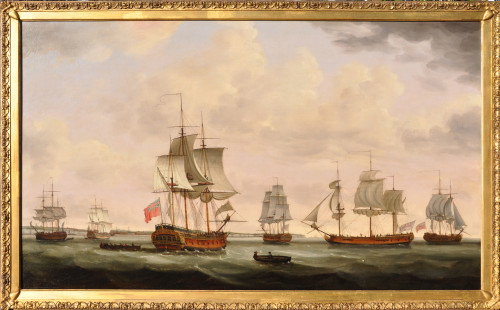
A Royal Navy first rate three-decker flying an Admiral of the Blue and a squadron off Gibraltar
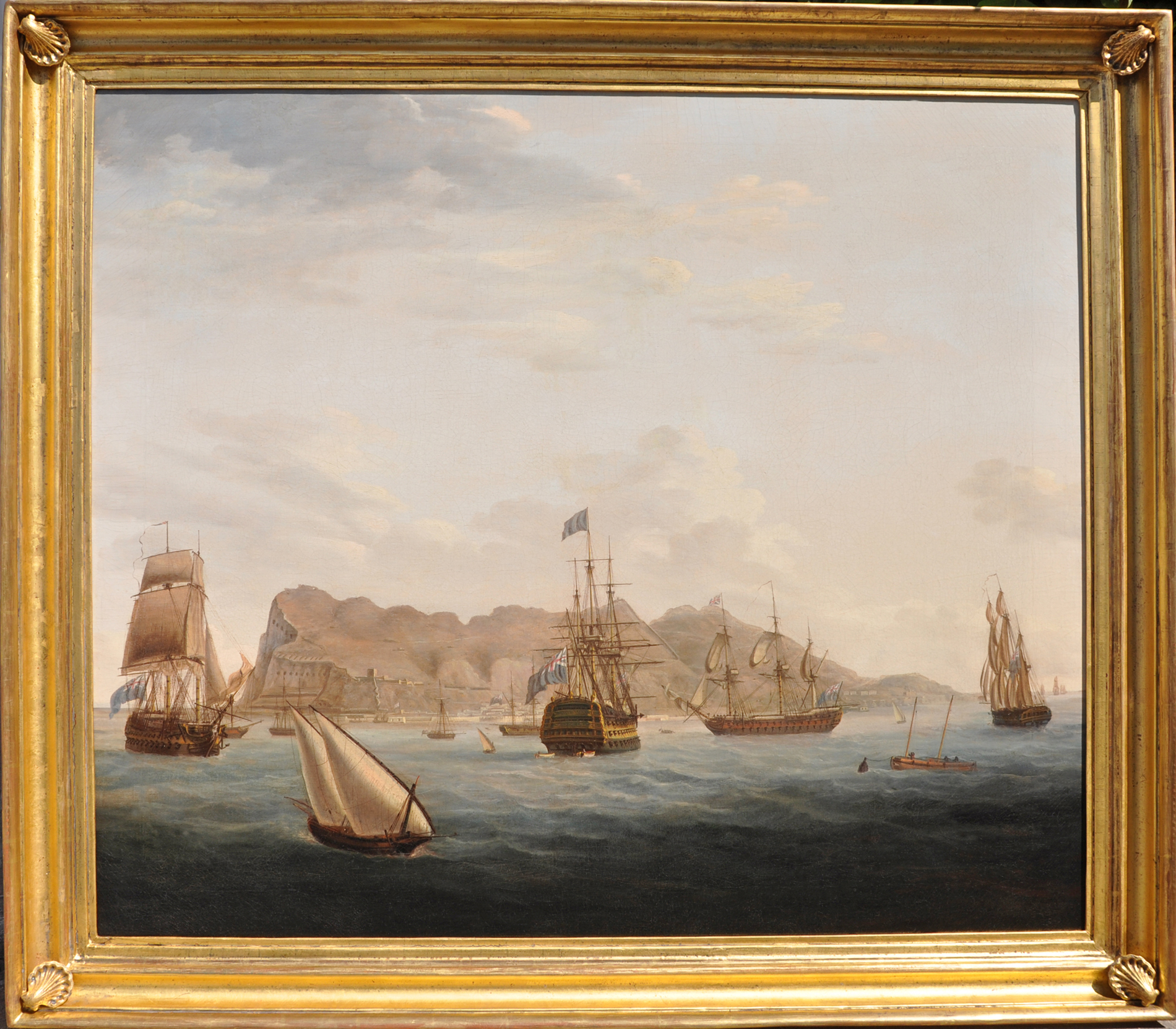
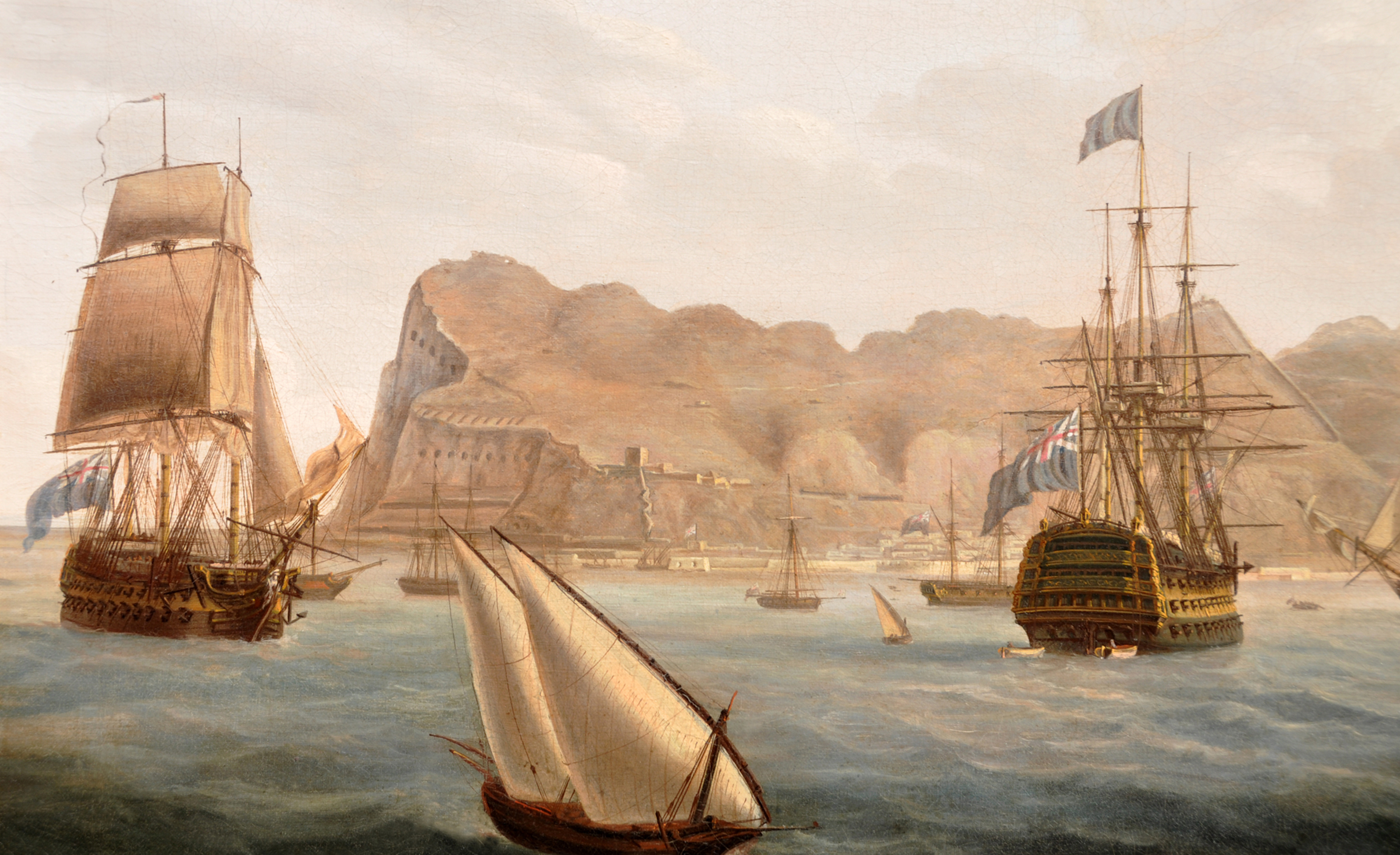
A Royal Navy first rate three-decker flying an Admiral of the Blue and a squadron off Gibraltar
ADAM CALLANDER
1750-1817
Scottish School
A Royal Navy first rate three-decker flying an Admiral of the Blue and a squadron off Gibraltar
Oil on canvas
91.5 x 10⁶ cms
36 x 413/4 inches
Overall framed size 103.7 x 119.2 cms
407/8 x 467/8 ins
The third son in a family of seventeen children, Adam Callander was born in 1750 in the Craigforth neighbourhood of Stirling, Scotland and his father John (d.1789) was an antiquary and lawyer.
It is not known where he trained as an artist although there is speculation that an acute studying of the Old Masters, often from prints, and subsequent copying of them, may have meant that he was self-taught. Although he had a career as a landscape and marine painter, he continued to reproduce the work of some British artists such as the portraitist Sir Joshua Reynolds and the Dutch Golden Age painters of the 17th century.
His early work was views of Scotland but by 1780 he was living in London, remaining there until his death in New Cavendish St on 5th August 1817. His first recorded address was at 3, Southampton Row, Paddington and then from 1781 to 1788 at 59 Queen Anne St and then 31 Tichfield St followed by 1 New Cavendish St.
His first exhibit at the Royal Academy, A view of Stirling Castle, a drawing was in 1780 and this was followed by a further fifty works at the R.A. up until 1811 and ten at the British Institution from 1806 until 1811, with watercolours and drawings forming the majority of these. He was particularly drawn to depicting the light at the beginning and end of the day, moonlight and for the atmospheric effect of fog and of the sun as it started to break through it. Titles such as Sun breaking through a fog; The effects of a fog; The effects of the clearing away of a fog with part of Shakespeare’s cliff; Effect of moon rising; A sunrise and Morning with cattle and figures are just a few examples of this passion to capture the light in his paintings.
Apart from painting Scottish scenes, Callander painted in England, Wales and Ireland and there are scenes overseas such as in Italy, India, Cape of Good Hope, St Helena, Tenerife and the West Indies. The last of these depicted the Paraclete Plantation on Grenada and was produced in 1789. There was a set of eight painted in gouache and watercolour and these are now in Paxton House near Berwick-on-Tweed, Scotland. One shows the view looking east from the plantation house and includes a stepped water feature which was not a type of grandiose folly typical of the 18th century but had a practical purpose in that the cut sugar cane could be floated downstream to the processing sheds lower down.
Callander, besides being an artist producing his own subject matter, also made copies of famous paintings, probably on a commission basis for clients. One of these was The missing bird, after Le Nain, painted in 1789. Judy Egerton, writing in Hogarth’s Marriage A-la Mode, states that “…the wide range of other copies whose work Callander is known similarly to have copied…Prolific copyist though he was, Callander was no forger”. She is writing specifically in this piece about the set of six paintings by William Hogarth which he had completed in 1743 and which were subsequently engraved in 1745. Judy Egerton goes on, “A set of painted copies (each approximately the same size as the originals) is known, and has from time to time been attributed to Hogarth himself.
Prolific copyist though he was, Callander was no forger. He put his copies of Marriage A-la Mode up for sale repeatedly (or perhaps continuously) in the European Museum in Pall Mall between 1806 and 1814 each time under his own name, and with the following statement in the printed catalogues: ‘These six instructive pictures, are the only copies ever taken from Hogarth’s set of Marriage A-la Mode,, in the possession of John Julius Angerstein, Esq. who liberally permitted Mr Callander, the ingenious artist, to spend several months in his house; that he might have ample time and opportunity to render them as near the originals as possible.’ Callander’s copies found no buyer between 1806 and 1814, nor in Mrs Callander’s sale of her late husband’s works at Christie’s held in 1817, which included Hogarth, a set of pleasing copies of the Marriage ala (sic) Mode (lot 6). Again, honestly offered as copies by Callander, they were bought in at £5. Thus, the attribution of the copies to Hogarth himself was never made by Callander himself, nor by his widow.
A further example of Callander producing versions of famous paintings was provided by Helen Smailes in 2022 when she notes that in January 1797 Callander wrote a letter from London to Sir William Forbes of Pitsligo, stating that he was particularly busy working on highly finished drawings on silk after Old Masters like Claude.
In February 1804, Callander lost a collection of his drawings in a fire at Frith St., Soho. These were valued at £700, a considerable sum, and to help mitigate this loss, the Royal Academy gave him 20 guineas. He died on 5th August 1817 at his home in New Cavendish St and the following year, Christie’s held a dispersal sale of all of his paintings which had been entered to the auction house by his widow.
Titles of some of his paintings include: Inside of a cottage; View of Ravenshaw Castle, Scotland, evening; A view of Kitchum Castle on Loch Awe, belonging to the Earl of Breadalbane; Luton Park Bedfordshire, from the south; View of the lighthouse, Dublin, the bay and hill of Howth – a gale; View of the Lake of Kilarney, with Muckrus, the seat of H A Herbert, Esq; View of the Vale of Towey up to Carmarthen; A view of the Double Cave, to the east of Margate; Highcliffe Castle , Dorset, from the east; Luton Park, Bedordshire from the south; View of the Cape of Good Hope with a signal, of wind and rain; View of Table Mountain and Cape Town, boats coming in from a shipwreck; View of the peak of Tenerife; View of the Island of St. Helena; Sun setting, with a view of Mount Vesuvius; Shipping off Madras;
Examples of Adam Callander’s work are held in the following museums and institutions: National Maritime Museum, Greenwich, London (2); Victoria and Albert Museum (4); British Museum; Stirling Castle Art Gallery and Museum, National Trust for Scotland at Culzean Castle; Paxton House, Berwick on Tweed.
We are grateful to Dr Pieter van der Merwe, MBE, DL for his help in the cataloguing of this painting.
Bibliography: The Dictionary of Sea Painters of Europe and America – E H H Archibald
The Dictionary of British 18th century Painters – Ellis Waterhouse
Hogarth's “Marriage à-la-Mode” - Judy Egerton,
British Museum website
ArtUK.org
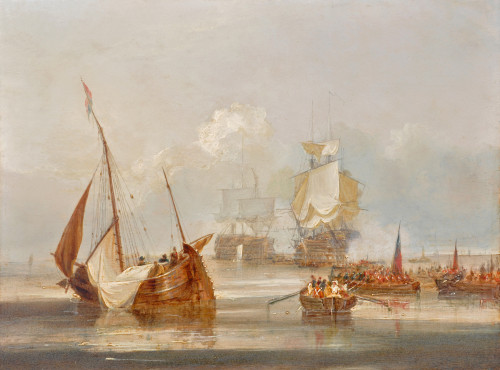
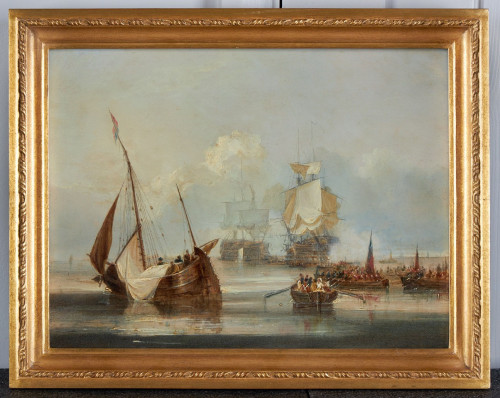
RELATED ITEMS




 was an antiquary and lawyer. It is not known where he trained as an artist although there is speculation that an acute studying of the Old Masters, often from prints, and subsequent copying of them, may have meant that he was self-taught. Although he had a career as a landscape and marine painter, he continued to reproduce the work of some British artists such as the portraitist Sir Joshua Reynolds and the Dutch Golden Age painters of the 17th century.His early work was views of Scotland but by 1780 he was living in London, remaining there until his death in New Cavendish St on 5th August 1817. His first recorded address was at 3, Southampton Row, Paddington and then from 1781 to 1788 at 59 Queen Anne St and then 31 Tichfield St followed by 1 New Cavendish St. His first exhibit at the Royal Academy, A view of Stirling Castle, a drawing was in 1780 and this was followed by a further fifty works at the R.A. up until 1811 and ten at the British Institution from 1806 until 1811, with watercolours and drawings forming the majority of these. He was particularly drawn to depicting the light at the beginning and end of the day, moonlight and for the atmospheric effect of fog and of the sun as it started to break through it. Titles such as Sun breaking through a fog; The effects of a fog; The effects of the clearing away of a fog with part of Shakespeare’s cliff; Effect of moon rising; A sunrise and Morning with cattle and figures are just a few examples of this passion to capture the light in his paintings.Apart from painting Scottish scenes, Callander painted in England, Wales and Ireland and there are scenes overseas such as in Italy, India, Cape of Good Hope, St Helena, Tenerife and the West Indies. The last of these depicted the Paraclete Plantation on Grenada and was produced in 1789. There was a set of eight painted in gouache and watercolour and these are now in Paxton House near Berwick-on-Tweed, Scotland. One shows the view looking east from the plantation house and includes a stepped water feature which was not a type of grandiose folly typical of the 18th century but had a practical purpose in that the cut sugar cane could be floated downstream to the processing sheds lower down.Callander, besides being an artist producing his own subject matter, also made copies of famous paintings, probably on a commission basis for clients. One of these was The missing bird, after Le Nain, painted in 1789. Judy Egerton, writing in Hogarth’s Marriage A-la Mode, states that “…the wide range of other copies whose work Callander is known similarly to have copied…Prolific copyist though he was, Callander was no forger”. She is writing specifically in this piece about the set of six paintings by William Hogarth which he had completed in 1743 and which were subsequently engraved in 1745. Judy Egerton goes on, “A set of painted copies (each approximately the same size as the originals) is known, and has from time to time been attributed to Hogarth himself. Prolific copyist though he was, Callander was no forger. He put his copies of Marriage A-la Mode up for sale repeatedly (or perhaps continuously) in the European Museum in Pall Mall between 1806 and 1814 each time under his own name, and with the following statement in the printed catalogues: ‘These six instructive pictures, are the only copies ever taken from Hogarth’s set of Marriage A-la Mode,, in the possession of John Julius Angerstein, Esq. who liberally permitted Mr Callander, the ingenious artist, to spend several months in his house; that he might have ample time and opportunity to render them as near the originals as possible.’ Callander’s copies found no buyer between 1806 and 1814, nor in Mrs Callander’s sale of her late husband’s works at Christie’s held in 1817, which included Hogarth, a set of pleasing copies of the Marriage ala (sic) Mode (lot 6). Again, honestly offered as copies by Callander, they were bought in at £5. Thus, the attribution of the copies to Hogarth himself was never made by Callander himself, nor by his widow.A further example of Callander producing versions of famous paintings was provided by Helen Smailes in 2022 when she notes that in January 1797 Callander wrote a letter from London to Sir William Forbes of Pitsligo, stating that he was particularly busy working on highly finished drawings on silk after Old Masters like Claude. In February 1804, Callander lost a collection of his drawings in a fire at Frith St., Soho. These were valued at £700, a considerable sum, and to help mitigate this loss, the Royal Academy gave him 20 guineas. He died on 5th August 1817 at his home in New Cavendish St and the following year, Christie’s held a dispersal sale of all of his paintings which had been entered to the auction house by his widow.Titles of some of his paintings include: Inside of a cottage; View of Ravenshaw Castle, Scotland, evening; A view of Kitchum Castle on Loch Awe, belonging to the Earl of Breadalbane; Luton Park Bedfordshire, from the south; View of the lighthouse, Dublin, the bay and hill of Howth – a gale; View of the Lake of Kilarney, with Muckrus, the seat of H A Herbert, Esq; View of the Vale of Towey up to Carmarthen; A view of the Double Cave, to the east of Margate; Highcliffe Castle , Dorset, from the east; Luton Park, Bedordshire from the south; View of the Cape of Good Hope with a signal, of wind and rain; View of Table Mountain and Cape Town, boats coming in from a shipwreck; View of the peak of Tenerife; View of the Island of St. Helena; Sun setting, with a view of Mount Vesuvius; Shipping off Madras; Examples of Adam Callander’s work are held in the following museums and institutions: National Maritime Museum, Greenwich, London (2); Victoria and Albert Museum (4); British Museum; Stirling Castle Art Gallery and Museum, National Trust for Scotland at Culzean Castle; Paxton House, Berwick on Tweed. We are grateful to Dr Pieter van der Merwe, MBE, DL for his help in the cataloguing of this painting. Bibliography: The Dictionary of Sea Painters of Europe and America – E H H Archibald The Dictionary of British 18th century Painters – Ellis Waterhouse Hogarth's “Marriage à-la-Mode” - Judy Egerton, British Museum website ArtUK.org )