
A full-length portrait of a young man in a red velvet jacket seated by a window, his greyhound standing before him
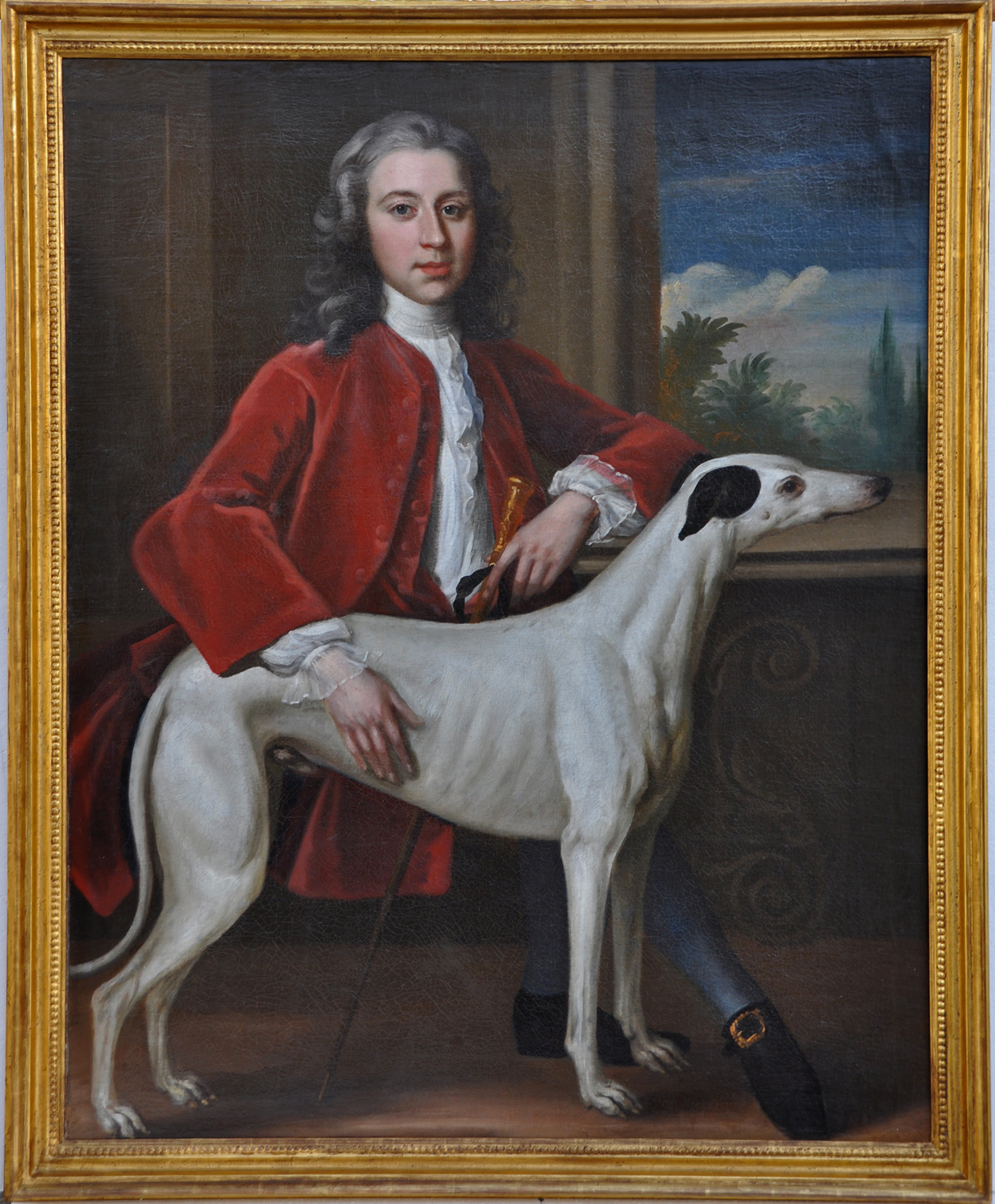
A full-length portrait of a young man in a red velvet jacket seated by a window, his greyhound standing before him
Attributed to JOHANNES KERSEBOOM
d.1708
Anglo-German School
A full-length portrait of a young man in a red velvet jacket seated by a window, his greyhound standing before him
Oil on canvas
127 x 101.5 cms
50 x 40 ins
Overall framed size 139 x 113.5 cms
54¾ x 44¾ ins
Johannes Kerseboom was born in Germany as Johann Kirschbaum (although sometimes he is recorded as Johan Kerseboom, Johann Kerseboom or John Kerseboom). He was the nephew of the portrait painter Frederick Kerseboom (1632-1690) and cousin of Frans Kerseboom (1632-1693)
He was raised in the Rhineland area of Germany and it is possible that his family members gave him instruction in painting. His uncle Frederick is believed to have studied in Paris under Charles Le Brun (1619-1690) who was the dominant painter and art theorist at the time of Louis XIV. Frederick then spent fourteen years in Rome working with Poussin.
Johannes initially worked in Germany before coming to England with his uncle in the early 1680s and the latter, who was a portrait painter, attempted to establish himself as a history painter but this venture was not particularly successful. Johannes however proved to be more adept as an artist and built up a larger clientele than his uncle of those wanting to have their portrait painted. The influence of Kneller and Lely can be discerned in his work and he often favoured portraying his sitters in three-quarter length poses with the males having crossed legs. In 1694 he was able to charge £16 10 shillings for a frames 50 x 40 inch portrait.
There are thirty-two portraits definitely ascribed to Johannes of which the most famous is of Robert Boyle, the eminent scientist, which was painted in 1689 and now hangs at the Royal Society in London. Other notable patrons included Gilbert Coventry, 4th Earl of Coventry and Thomas Osborne, 1st Duke of Leeds. A number of his portraits were engraved in mezzotint by John Smith and others.
Johannes Kerseboom occasionally collaborated with the Dutch-born portraitist, animal and landscape painter Jan van der Vaart – he and Kerseboom both used the engraver John Smith – and one example of this was the previously mentioned Duke of Leeds portrait.
Johannes Kerseboom died in London in 1708 and was buried in St Paul’s, Covent Garden on 26th October.
Examples of paintings and mezzotints are held in the collections of the following museums and institutions: National Portrait Gallery; Ashmolean Museum; Fitzwilliam Museum; Royal Society; Lincoln College, University of Oxford; Torrington Town Hall; National Trust: Calke Abbey, Antony, Stourhead, Hardwick Hall.
Bibliography:
The Dictionary of British 16th & 17th Century British Painters – Ellis Waterhouse
Dictionnaire des Peintres – E Benezit
RKD database
National Portrait Gallery
RELATED ITEMS




. He was the nephew of the portrait painter Frederick Kerseboom (1632-1690) and cousin of Frans Kerseboom (1632-1693)He was raised in the Rhineland area of Germany and it is possible that his family members gave him instruction in painting. His uncle Frederick is believed to have studied in Paris under Charles Le Brun (1619-1690) who was the dominant painter and art theorist at the time of Louis XIV. Frederick then spent fourteen years in Rome working with Poussin.Johannes initially worked in Germany before coming to England with his uncle in the early 1680s and the latter, who was a portrait painter, attempted to establish himself as a history painter but this venture was not particularly successful. Johannes however proved to be more adept as an artist and built up a larger clientele than his uncle of those wanting to have their portrait painted. The influence of Kneller and Lely can be discerned in his work and he often favoured portraying his sitters in three-quarter length poses with the males having crossed legs. In 1694 he was able to charge £16 10 shillings for a frames 50 x 40 inch portrait.There are thirty-two portraits definitely ascribed to Johannes of which the most famous is of Robert Boyle, the eminent scientist, which was painted in 1689 and now hangs at the Royal Society in London. Other notable patrons included Gilbert Coventry, 4th Earl of Coventry and Thomas Osborne, 1st Duke of Leeds. A number of his portraits were engraved in mezzotint by John Smith and others.Johannes Kerseboom occasionally collaborated with the Dutch-born portraitist, animal and landscape painter Jan van der Vaart – he and Kerseboom both used the engraver John Smith – and one example of this was the previously mentioned Duke of Leeds portrait.Johannes Kerseboom died in London in 1708 and was buried in St Paul’s, Covent Garden on 26th October.Examples of paintings and mezzotints are held in the collections of the following museums and institutions: National Portrait Gallery; Ashmolean Museum; Fitzwilliam Museum; Royal Society; Lincoln College, University of Oxford; Torrington Town Hall; National Trust: Calke Abbey, Antony, Stourhead, Hardwick Hall. Bibliography:The Dictionary of British 16th & 17th Century British Painters – Ellis WaterhouseDictionnaire des Peintres – E Benezit RKD databaseNational Portrait Gallery)